
We’ve all heard horrifying stories about the financialization of rental housing from the news and even from our friends and neighbours who have experienced it first-hand. It’s a huge problem. It’s easy to blame the landlords and large development companies. They are the bad guys in this story, right? Greed, indifference to human suffering, callous policies that lead to “renovictions” and above standard rent increases. Even small landlords may participate in unethical practices such as “cash for keys” schemes or renovictions to maximize profits.
The problem may seem obvious, but let’s dive a little deeper. What is leading to this behaviour?
At the Mill we have been in a perpetual tug of war with nature as we wait to begin construction on the Mill Block equitable housing community. Our board member Paul has been diligent in working with our pest control company to keep unwanted pests from overtaking the mill. Imagine a paradise of leftover grain and animal feed residue waiting for you in a warm sheltered place with no human interference. Perfection for the mice, but not for us humans! Last spring we dealt with a few rats (Eww I know). The rats happily ate the mice. However, after the rats were eradicated, the mice came back. Now we work constantly to evict them from the hidden corners of the Mill.
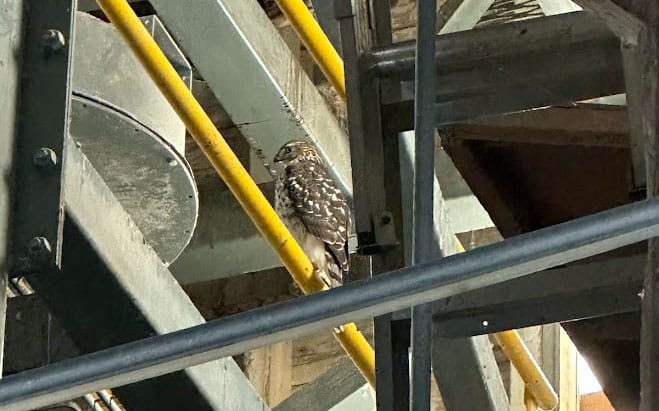
This fall we had new unwanted tenants, pigeons. They had taken up residence in the upper floors of the mill and were creating a toxic mess of pigeon poop. Imagine our surprise when Paul arranged to remove them and found a new tenant, a large hawk. The pigeons were gone: the hawk had aggressively evicted them (ok, here my analogy breaks down a bit, human landlords don’t actually eat their tenants) but nonetheless, I find some parallels between the natural world and the human world.
The unoccupied Mill has been subject to a natural “ecosystem” predator vs prey. Our current Canadian housing ecosystem favours the predators. It also allows people to be aggressively territorial (just like the natural world). This surfaces in the form of NIMBYism. “Of course, we all support affordable housing, it just isn’t right for our neighbourhood”. The claws and teeth used in these situations are legislation, money and power.
This ecosystem has built up over many years. Those of us fortunate enough to have stock investments want to see our portfolios grow, this is achieved by maximizing profits. We are all hungry for more. In Ontario, in the early nineties, those in leadership decided to relax some rent controls and allow unlimited rent increases for unoccupied units. At the same time, they stopped investing in government owned social housing. The effects of those decisions reverberate today.
Real estate as a good investment is not a new concept, in the 1930’s Franklin D. Roosevelt said
“Real estate cannot be lost or stolen, nor can it be carried away. Purchased with common sense, paid for in full, and managed with reasonable care, it is about the safest investment in the world.”
Investing in real estate, or any other industry is not a bad thing in and of itself. It is part of the massive ecosystem we have developed to grow wealth. But as with any natural ecosystem, things can get out of balance. Our Canadian housing system is out of balance.
How do we change such a massive ecosystem built up over many years? It takes time. It will take both systemic changes and crises intervention. Neither of these approaches can succeed without the other. We also need to acknowledge that some of the wealth we have built came to us as a result of a system that seeks to maximize profits. And yes, these conclusions and solutions may be a bit uncomfortable.
If we look back to the natural world, sometimes our human progress causes an imbalance in a particular ecosystem. Take sea turtles in Costa Rica as an example. Some species have become endangered due to degradation of their natural nesting habitat or locals eating and selling turtle eggs as a delicacy. The systematic approach was to protect and re-naturalize nesting areas. An education program was also needed to teach locals of the harm in eating turtle eggs. The crises intervention approach was to invest money in creating protected areas for turtles to lay eggs until their natural habitats (and balance) are restored.
At LYNC we are acting on both approaches. We are advocating for systemic changes by participating in advocacy, round tables, meeting with our local leaders, educating and informing our community about the housing crises. Building the Mill Block Community could be considered both a systematic and crises intervention action. By building housing as a non-profit we are moving housing away from the profit-making world. By mustering every bit of grit and patience we have to push through the massive bureaucracy it takes to get something done, we are working to address a crisis. There are currently 2,371 people experiencing homelessness in Waterloo Region (stats as of October 2024). In Wilmot Township, the Wilmot Family Resource Centre reported that last year they supported 20 – 30 people each month who were living in cars or in inadequate, unsafe situations. This is a true crisis.
What can you do as an individual? Consider a dual approach.
Fight for systematic change. Raise your voice to let people know that this ecosystem is not ok. Advocate, vote and get involved. Most importantly, be open to affordable housing in your own neighbourhood.
Work to mitigate the crisis of those experiencing housing insecurity now. LYNC is operating right here in Wilmot Township and we are working to remove the profit element from housing. We need your support; give generously.
Although it may take time, effort, patience and a lot of compassion, we can both care for people in need and make systemic changes together.
Lisa Doherty, Vice-Chair, LYNC Board of Directors